Ph.D. Student in Public Administration, Islamic Azad University, Dehaghan Branch, Isfahan, Iran.
Abstract
Methodology: In terms of purpose, this study was applied research, and in terms of methodology, it employed a descriptive-correlational design with a quantitative approach. The statistical population consisted of all 380 employees of the Social Security Organization of Chaharmahal and Bakhtiari Province. Based on Cochran’s formula, a sample of 191 employees was selected using proportionate stratified random sampling. Data were collected using standard work–life balance questionnaires and the Maslach Burnout Inventory (MBI). The content validity of the questionnaires was confirmed using the Content Validity Index (CVI), with values of 0.92 and 0.90, respectively. Their reliability was also confirmed using Cronbach’s alpha coefficients of 0.89 and 0.87, respectively. Data were analyzed using structural equation modeling (SEM) and SPSS and LISREL software. Findings: The results indicated a significant inverse relationship between the implementation of work–life balance policies and the dimensions of job burnout, including emotional exhaustion, depersonalization, and reduced personal accomplishment (P < 0.05). The path coefficient between work–life balance and emotional exhaustion was β = −0.58, between work–life balance and depersonalization was β = −0.42, and between work–life balance and reduced personal accomplishment was β = −0.36, indicating moderate to strong effects. Furthermore, the model fit indices (RMSEA = 0.062, CFI = 0.94, NFI = 0.91) demonstrated an acceptable fit of the proposed conceptual model.
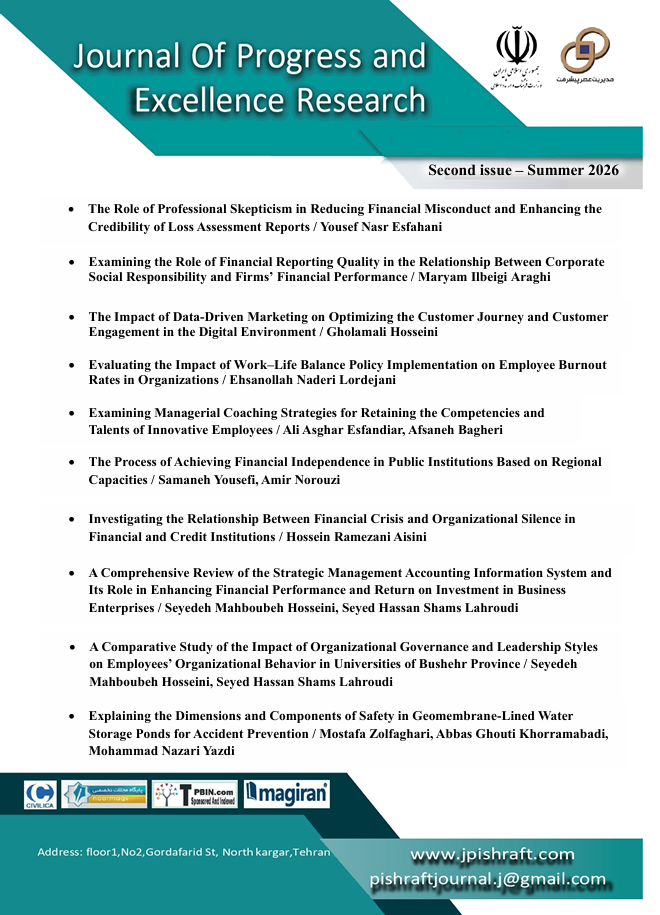
Naderi Lordjani, E. (2026). The Impact of Work–Life Balance Policies on Employee Burnout: A Case Study of the Social Security Organization of Chaharmahal and Bakhtiari Province. Progress and Excellence Research, 9(2), 33-44.
MLA
Naderi Lordjani, E. "The Impact of Work–Life Balance Policies on Employee Burnout: A Case Study of the Social Security Organization of Chaharmahal and Bakhtiari Province", Progress and Excellence Research, 9, 2, 2026, 33-44.
HARVARD
Naderi Lordjani E. (2026). 'The Impact of Work–Life Balance Policies on Employee Burnout: A Case Study of the Social Security Organization of Chaharmahal and Bakhtiari Province', Progress and Excellence Research, 9(2), pp. 33-44.
CHICAGO
E. Naderi Lordjani, "The Impact of Work–Life Balance Policies on Employee Burnout: A Case Study of the Social Security Organization of Chaharmahal and Bakhtiari Province," Progress and Excellence Research, 9 2 (2026): 33-44,
VANCOUVER
Naderi Lordjani E. The Impact of Work–Life Balance Policies on Employee Burnout: A Case Study of the Social Security Organization of Chaharmahal and Bakhtiari Province. Progress and Excellence. 2026;9(2):33-44 (In Persian).